

Internal Laying in Chickens: What Is It and What Should You Watch For?
Updated: 2 days ago
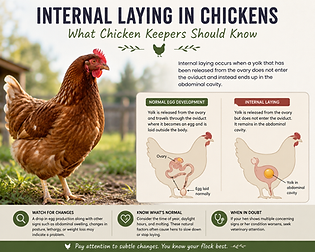
If you keep laying hens, you may eventually hear the term internal laying. It can sound confusing at first, and it is sometimes mistaken for egg binding or egg yolk peritonitis.
Internal laying in chickens is a reproductive problem in which a yolk that has been released from the ovary does not travel through the oviduct normally. Instead, the yolk ends up inside the hen's abdominal cavity.
Unlike a normal egg, which is eventually laid outside the body, an internally laid yolk remains inside the hen.
What Normally Happens When a Hen Lays an Egg?
A hen produces yolks in her ovary. When a yolk is released, it normally enters the oviduct and begins its journey toward becoming an egg.
As it travels through the reproductive tract, the different components of the egg are added before the finished egg is laid.
With internal laying, this normal process doesn't happen.
Instead, the yolk remains within the abdominal cavity.
What Can Cause Internal Laying in Chickens?
There isn't always one obvious reason why a hen becomes an internal layer.
Problems involving the reproductive tract can interfere with the normal movement of yolks.
Reproductive disease, abnormalities, inflammation, or damage to the oviduct may play a role.
Some hens may also develop reproductive problems as they age.
In many cases, it may not be possible to determine exactly why a particular hen has become an internal layer.
What Does an Internal Layer Look Like?
The signs can vary considerably from one hen to another.
A reduction or complete stop in egg production can occur with internal laying, but this sign must be considered in context because seasonal changes and molting naturally cause many hens to reduce or temporarily stop laying.
Other possible signs include:
Enlarged or swollen abdomen
A change in posture
A "penguin-like" stance
Reluctance to move
Lethargy
Reduced appetite
Weight loss
Abdominal discomfort
Difficulty breathing in more advanced cases
Not every hen will show every sign.
Some hens may continue to appear relatively normal for a period of time, which can make internal laying difficult to recognize.
A Hen Stopping Laying Doesn't Always Mean Something Is Wrong
Before becoming concerned about internal laying, it's important to consider the time of year and what is normal for your hen.
Hens naturally reduce or stop egg production during certain times of the year. Shorter daylight hours in the fall and winter can cause egg production to decrease, and many hens temporarily stop laying while they are going through their annual molt.
This is a normal part of a hen's reproductive cycle and does not mean that she has become an internal layer.
A hen that gradually slows down or stops laying as the days become shorter, particularly when she is also molting and otherwise healthy and active, may simply be experiencing a normal seasonal change.
The concern is different when a hen that would normally be laying develops other unusual signs at the same time, such as abdominal swelling, an abnormal posture, lethargy, weight loss, or a noticeable decline in her overall condition.
It's important to look at the whole picture, rather than assuming that a decrease in egg production by itself indicates a reproductive problem.
When a Change in Egg Production May Be Worth Investigating
Consider the circumstances surrounding the change.
A normal seasonal change may look like:
Egg production gradually decreases as daylight hours shorten
The hen is going through a molt
The hen remains active and alert
She continues eating and drinking normally
Her body condition remains healthy
There are no other concerning symptoms
A reproductive problem may be more concerning when:
A hen stops laying at an unexpected time
The change is accompanied by abdominal enlargement
Her posture changes
She becomes unusually quiet or inactive
She loses weight or body condition
Her appetite decreases
She develops breathing difficulties
Her overall condition progressively deteriorates
No single symptom can diagnose internal laying. Looking at the combination of signs and the hen's overall health is much more useful.
Why Does Internal Laying Matter?
The yolk is not supposed to remain loose within the abdominal cavity.
When yolk accumulates, it can irritate the surrounding tissues and cause inflammation.
In some cases, this can progress to egg yolk peritonitis, particularly if secondary infection develops.
This is one reason internal laying can become a serious reproductive problem rather than simply a hen that has stopped laying eggs.
Internal Laying vs. Egg Yolk Peritonitis
These terms are sometimes used interchangeably, but they describe different things.
Internal laying refers to the abnormal location of the yolk — the yolk has ended up inside the abdominal cavity rather than travelling normally through the oviduct.
Egg yolk peritonitis refers to the inflammatory condition that can develop when yolk material is present within the abdominal cavity.
In other words, internal laying can contribute to the development of egg yolk peritonitis, but the two terms do not mean exactly the same thing.
This distinction is important when trying to understand reproductive problems in hens.
Is a Swollen Abdomen Always Internal Laying?
No.
An enlarged abdomen can have many possible causes, and internal laying is only one of them.
Other reproductive and health problems can produce similar signs, including impacted oviduct, egg yolk peritonitis, fluid accumulation, ovarian problems, and other abdominal conditions.
This is why it is important not to assume that a hen with a swollen abdomen is automatically an internal layer.
When Should You Be Concerned?
If a hen suddenly stops laying and you also notice changes such as abdominal enlargement, an unusual posture, lethargy, weight loss, or difficulty breathing, she should be taken seriously.
A hen that is becoming progressively weaker or having difficulty breathing needs prompt veterinary attention.
Because several conditions can produce similar symptoms, determining the underlying problem may require a veterinary examination.
Can Internal Laying Be Prevented?
Unfortunately, there is no way to prevent every case of internal laying.
Good overall flock management is still important. Providing hens with a nutritionally complete diet, maintaining appropriate body condition, minimizing unnecessary stress, and paying attention to changes in health can all contribute to good reproductive health.
Most importantly, know what is normal for your hens.
A change in egg production can sometimes be the first indication that something is wrong.
Watch for Changes in Your Laying Hens
Backyard chicken keepers often become very familiar with their hens' individual habits.
You may know which hen lays every morning, which one prefers a particular nest box, and which one is always first to the feeder.
That familiarity can be incredibly useful.
When a normally productive hen suddenly stops laying, develops a swollen abdomen, changes her posture, or becomes less active, don't simply assume that she is taking a break from laying.
A change in reproductive function can sometimes be an early sign of an underlying problem.
Want to Understand Reproductive Problems More Fully?
Internal laying is only one of the many reproductive problems that can affect hens.
If you want to learn more about the different reproductive conditions, how they can differ from one another, and the signs that chicken keepers should watch for, our Reproductive Health Reference Guide provides more detailed information.
Understanding what is happening inside a hen can help you recognize when something isn't right — and knowing what to look for is one of the most important parts of caring for a backyard flock.
Internal laying can sometimes lead to egg yolk peritonitis. Learn more about this serious reproductive condition in our next weeks article: [Egg Yolk Peritonitis in Chickens].
Recommended Reading:


Comments