

Feeding a Mixed Flock: Understanding the Nutritional Needs of Laying Hens and Roosters
- 13 hours ago
- 5 min read
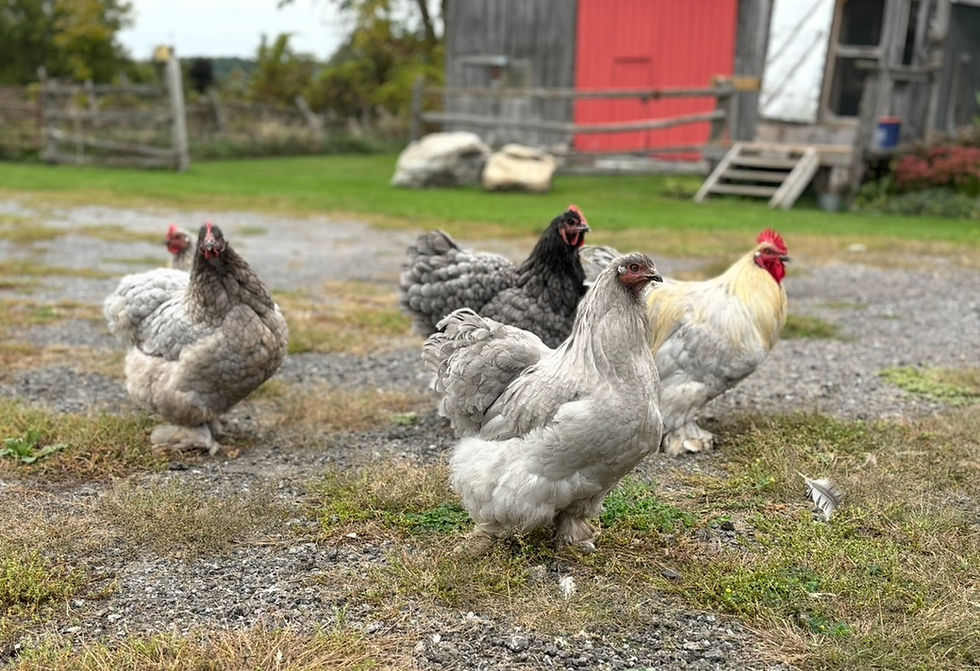
Many backyard chicken keepers eventually find themselves managing a mixed flock with both laying hens and roosters. One of the most common questions that comes up is:
“Can roosters eat layer feed?”
There is a lot of conflicting information surrounding this topic. Some people believe roosters should never consume layer feed because it contains more calcium, while others feed their entire flock the same ration.
The answer requires looking beyond a single ingredient and understanding the nutritional needs of the flock as a whole.
When managing a mixed flock, the goal should be to provide a diet that supports the birds with the highest nutritional demands — and in most backyard flocks, those birds are the laying hens.
Laying Hens Have the Highest Nutritional Demands
A laying hen is one of the most nutritionally demanding birds in a backyard flock.
Producing eggs requires a tremendous amount of nutrients every day. An egg is not simply made from calcium; it requires a carefully balanced combination of:
Protein and essential amino acids for egg formation
Energy to support production
Calcium for eggshell formation
Phosphorus for proper calcium utilization and bone health
Vitamins and trace minerals that support reproduction, metabolism, and overall health
A productive hen is constantly using nutrients from her diet to support egg production.
This is why laying hens require a feed specifically formulated to meet the demands of ongoing egg production.
Feeding a Mixed Flock Is About Finding the Best Nutritional Balance
In an ideal world, every bird would receive a diet formulated specifically for its stage of life and nutritional requirements. Growing chicks, laying hens, roosters, and breeding birds all have different needs.
However, when hens and roosters live together and share feeders, it is generally not practical to provide each bird with a separate diet. They eat from the same feeders throughout the day, making it difficult to control exactly what each bird consumes.
Instead, the goal is to choose the feeding program that best supports the flock as a whole.
In most backyard flocks, laying hens greatly outnumber roosters and have the highest nutritional demands. For that reason, many keepers choose to feed a complete layer ration that provides the nutrients needed to support egg production, while recognizing that the rooster will also consume that feed.
Managing a mixed flock is about finding the best nutritional balance—not creating a perfect diet for every individual bird.
Layer Feed Is More Than Just Added Calcium
One of the biggest misconceptions about poultry feed is that layer feed is simply regular chicken feed with extra calcium added.
While the higher calcium level is one of the most noticeable differences, layer feed is formulated with the nutritional needs of laying hens in mind.
A laying hen requires a balanced nutrient profile designed to support:
Egg production
Egg quality
Bone strength
Reproductive health
Overall flock health
Grower feeds are designed for growing pullets that are developing muscle, bones, and body structure. All-flock feeds are designed as a maintenance ration for mixed poultry groups.
These feeds serve different purposes because birds at different life stages have different nutritional requirements.
Why Oyster Shell Does Not Make Another Feed Equivalent to Layer Feed
A common feeding approach is providing an all-flock or grower feed and offering oyster shell separately for laying hens.
Providing free-choice oyster shell can be beneficial because it allows laying hens to consume additional calcium when needed. However, oyster shell only supplies calcium.
It does not provide the complete nutritional profile of a layer ration.
Adding oyster shell to another feed does not automatically transform that feed into a layer feed because egg production requires much more than calcium alone.
A hen needs the correct balance of protein, amino acids, energy, vitamins, and minerals to support her body's daily demands.
Calcium is only one piece of the nutrition puzzle.
How Does Layer Feed Affect a Rooster?
The biggest concern many people have with feeding layer feed to roosters is the calcium content.
Unlike hens, roosters do not produce eggs and therefore do not have the same daily calcium requirement.
A rooster consuming layer feed will not use the additional calcium for eggshell production.
Any excess calcium that is not needed by the body must be processed and eliminated, primarily through the kidneys.
This is why roosters have a lower calcium requirement than laying hens.
However, it is important to look at the situation realistically. A rooster sharing a feeder with a flock of laying hens is very different from a rooster-only flock being fed a high-calcium layer ration.
In many backyard flocks, hens greatly outnumber roosters. Since the hens are consuming the majority of the feed and have the greatest nutritional demands, many keepers choose to feed a quality layer ration as the primary diet for the entire flock.
The overall health of the flock depends on meeting the needs of the birds that require the most nutrition.
How I Feed My Mixed Flock
In my own flock, my hens greatly out number my roosters
Because laying hens have the highest nutritional requirements, my priority is ensuring they receive a complete and balanced diet formulated for egg production.
My flock is fed layer feed, and my roosters eat the same feed.
The reason is simple:
The nutritional needs of the laying hens are driving the nutritional needs of the flock.
This approach works well for my flock because the majority of the birds consuming the feed are laying hens.
When Would You Choose a Different Feeding Approach?
There are situations where another feeding strategy may make more sense.
Examples include:
A rooster-only flock
A flock consisting only of roosters does not require a layer ration.
Growing chicks and pullets
Young birds that have not started laying have different nutritional requirements and should be fed an appropriate starter or grower feed.
Breeding programs with specific goals
Some breeders may choose specialized breeder diets depending on their objectives.
Multi-species flocks
Ducks, geese, and other poultry species may have different nutritional requirements.
The important thing is understanding the needs of the birds you are feeding.
The Bigger Nutrition Problem: Diluting a Balanced Diet
When discussing poultry nutrition, the focus often becomes one ingredient — calcium, protein, or a particular supplement.
However, one of the most common nutritional problems in backyard flocks is not the type of feed being offered. It is the amount of extras being added.
Treats, scratch grains, corn, kitchen scraps, and other additions can dilute the balanced nutrition provided by a complete poultry feed.
A bird cannot correct an unbalanced diet simply by eating more treats or receiving random supplements.
The foundation of flock health should always be:
A nutritionally complete poultry feed offered as the primary diet.
Final Thoughts
There is rarely a perfect feeding program that satisfies every bird in a mixed flock. Every feeding strategy involves balancing the nutritional needs of birds with different requirements. By understanding those differences, you can make informed feeding decisions based on the needs of your flock rather than relying on one-size-fits-all advice.
Feeding a mixed flock does not need to be complicated.
Rather than focusing on one rule that applies to every situation, consider the needs of the birds in your own flock.
Laying hens have the highest nutritional demands because of the daily process of egg production. Roosters have different requirements, particularly when it comes to calcium.
When hens make up the majority of the flock, many backyard keepers choose a quality layer ration because it supports the birds with the greatest nutritional needs.
There is no single feeding program that is perfect for every flock. The best approach is to understand the nutritional needs of the birds you are caring for and choose a feeding program that supports the flock as a whole.
Good flock nutrition starts with understanding the bird — not just the label on the feed bag.
Recommended Reading:


Comments